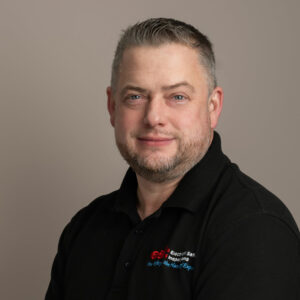
Jamie Morgan, Principal Fire Safety Consultant at ESI: Fire Safety, was accepted as a Member of the Institute of Fire Safety Managers on 11 August 2025. The professional membership grade allows Jamie to use the post-nominal letters MIFSM and recognises sustained experience, knowledge and involvement in fire safety management.
For Jamie, achieving MIFSM membership reflects a career that has developed over more than 20 years. It began in electrical safety and compliance before expanding into fire protection, fire alarm systems, emergency lighting, portable extinguishers, fire risk assessment, DSEAR and wider fire safety consultancy.
The breadth of that experience matters. Fire safety decisions cannot be made properly without understanding how buildings are used, how equipment is maintained, what substances and processes are present and how people behave during ordinary work and emergencies.
Experience across a wide range of working environments
Jamie has worked in offices, retail premises, hospitality venues, schools, colleges, residential buildings, factories, warehouses, workshops, construction environments and complex commercial properties. Each setting creates a different combination of fire hazards, occupant characteristics, escape arrangements and management challenges.
An office may appear relatively straightforward, but alterations, storage, electrical equipment, disabled evacuation arrangements and poor management records can still create significant risk. A factory or workshop may add process machinery, hot work, flammable liquids, dust, gas cylinders and complex shutdown arrangements. A residential or heritage property may require a careful balance between life safety, existing construction and proportionate improvements.
Jamie’s experience has also included hazardous areas where potentially explosive atmospheres require additional controls. This includes workplaces affected by the Dangerous Substances and Explosive Atmospheres Regulations 2002, commonly known as DSEAR, and the ATEX framework for equipment intended for use in explosive atmospheres.
ESI: Fire Safety now provides specialist DSEAR risk assessments for low to medium risk environments across Surrey, Berkshire, Hampshire and London.
Hazardous areas, ATEX and COMAH experience
Some workplaces use, store or generate flammable gases, vapours, liquids, mists or combustible dusts. In those environments, a general fire risk assessment is only part of the picture. The assessor also needs to understand hazardous area classification, ignition sources, ventilation, process activities, storage arrangements, equipment selection and emergency procedures.
Jamie has worked on industrial facilities and sites operating within the Control of Major Accident Hazards Regulations, known as COMAH. These sites require strong systems for controlling dangerous substances and managing events that could have serious consequences for employees, neighbouring communities, the environment and business continuity.
“I am delighted to have been accepted as a Member of the Institute of Fire Safety Managers. Achieving MIFSM is an important professional milestone and recognises the experience I have developed across more than 20 years of working within electrical safety, fire protection and regulatory compliance.
My career has taken me into an enormous variety of working environments, from relatively straightforward offices and retail premises through to factories, workshops, hazardous areas and COMAH-regulated industrial sites. Each type of building and activity presents different risks, and that experience has helped me develop a practical understanding of how fire safety measures need to work in real buildings and operational businesses.”
Why practical experience matters in fire safety
Qualifications provide essential technical knowledge, but competence also requires the ability to apply that knowledge to real situations. A measure that appears suitable in a generic specification may not work effectively if it conflicts with the way a building is occupied, maintained or managed.
For example, an evacuation plan must consider who is present and how they will respond. A fire alarm category must reflect the detection needs and escape strategy. Extinguishers must suit the hazards and the people expected to use them. Fire doors and compartmentation must be assessed as part of the building’s wider strategy, not as isolated products.
Jamie’s background in electrical inspection and fire protection gives him a detailed understanding of active systems as well as the management and building issues considered during a fire risk assessment.
“Working in hazardous and industrial environments teaches you that fire safety cannot be considered in isolation. You need to understand the building, the work activities, the substances being used, the equipment installed and the way people actually operate the premises.
A control that appears suitable on paper may be ineffective if it does not reflect the realities of production, maintenance, storage or human behaviour. My approach has always been to provide advice that is technically informed but also practical, proportionate and achievable for the client.”
About the Institute of Fire Safety Managers
The Institute of Fire Safety Managers is a professional, non-profit body dedicated to advancing fire safety at local, national and international levels. The Institute supports people working across fire safety management, fire risk assessment, active and passive fire protection and related disciplines.
The IFSM was originally formed in 1993 to provide a professional community for people involved in fire safety management within industry and commerce. It was re-established by a new Council in 2005 and formally incorporated under its current name in 2006.
Member grade is intended for experienced practitioners who can demonstrate relevant qualifications or sustained professional involvement, together with a commitment to continuing professional development. MIFSM is a professional membership grade and should not be confused with registration as a fire risk assessor or third-party company certification.
Supporting the continued growth of ESI: Fire Safety
Professional membership gives Jamie access to technical information, professional events, industry updates and a community of people working across different areas of fire safety. It also supports the continued development of ESI: Fire Safety as an independent consultancy.
“Professional membership is important because fire safety is a field in which learning never stops. Legislation changes, British Standards develop, new technologies introduce different risks and our understanding of building safety continues to improve.
Being part of the IFSM provides access to shared knowledge and experience from professionals working across many different parts of the industry. It supports our aim of providing clients with clear advice that helps them understand risk, prioritise improvements and make informed decisions.”
Jamie’s professional background and current work can be viewed on his LinkedIn profile. Organisations needing fire risk assessment, fire strategy, DSEAR or fire safety consultancy support can visit ESI: Fire Safety or call 01276 300351.