
What is hot work? A plain English definition
If you manage a building, run a business, or are responsible for a site where contractors come and go, hot work is something you need to understand.
Not because it sounds technical. Because it causes fires.
Hundreds of them, every year, across the UK. Some are caught early. Some destroy buildings. Some kill people.
This article explains what hot work actually is, why it carries such a significant fire risk, and what real incidents tell us about where things go wrong.
Hot work is any activity that generates heat, sparks, or a naked flame that could ignite nearby materials.
The British Standards Institution, in BS 9999, defines it as any procedure that might involve or have the potential to generate sufficient heat, sparks, or flame to cause a fire.
In practice, hot work covers a wide range of tasks that are routine on both construction sites and occupied premises. These include:
- Welding, including MIG, TIG, arc, and gas welding
- Flame cutting and oxy-acetylene cutting
- Grinding and the use of cutting discs
- Soldering and brazing
- Torch-on roofing and the use of blow lamps
- Heat guns and hot air blowers
- Thawing frozen pipes with a heat source
- Bitumen and tar boilers
- Lead heaters
Some of these will be immediately familiar. A roofer using a gas torch to apply felt. A plumber soldering a copper joint. A welder working on a steel frame. A maintenance engineer using an angle grinder on a bracket in a plant room.
What all of these activities have in common is this: they introduce a source of ignition into an environment that may contain combustible materials, hidden voids, dust, stored goods, or building fabric that will burn.
Why is hot work such a significant fire risk?
The fire triangle needs three things: heat, oxygen, and fuel. Hot work provides the heat. Buildings, by their very nature, provide both oxygen and fuel in abundance.
The problem is not always obvious while the work is happening. The spark that causes the fire is often invisible. It travels further than anyone expects. It lands somewhere no one was watching. And then it quietly smoulders.
Flying sparks travel further than you think
A single spark from welding or grinding can travel several metres before landing. Sparks can pass through gaps, land in voids, settle in dust, or come to rest against combustible materials hidden behind walls, above ceilings, or beneath floors.
Once a spark is in a concealed space, it can smoulder for hours before anyone knows there is a problem.
Heat transfer through metal
A copper pipe being soldered at one end conducts heat along its full length. That heat can ignite insulation, timber joists, or other combustible materials in contact with the pipe some distance from where the work is taking place.
Hot bitumen, molten metal droplets, and welding slag can also fall into voids or land on materials below the work area, starting fires that remain hidden until they take hold.
Hidden voids and combustible building fabric
Modern and older buildings alike contain timber, insulation, bitumen-coated membranes, polystyrene, wiring insulation, felt, and countless other materials that can ignite. Many of these are concealed within wall and floor voids, roof spaces, service risers, and ductwork.
A spark that enters a void can start a fire in a location where it will not be detected for a considerable time. By the time smoke becomes visible, the fire may already be well established.
The danger after the work stops
This is one of the most significant and least understood aspects of hot work risk, and it catches people out time and again.
Most people assume the danger ends when the contractor packs up and leaves. In reality, some of the most serious hot work fires start after the work has finished.
According to guidance from HSB Munich Re, the majority of major hot work losses occur sometime after the work has been completed. Smouldering materials go unnoticed and develop into fires when the area or building is unoccupied, with no one present to raise the alarm or intervene. Their guidance recommends a minimum post-work fire watch of 30 continuous minutes, followed by periodic checks for at least a further 30 minutes. Where significant combustible loading or combustible construction is present, those periodic inspections should continue for two hours or more after the work is completed.
What do the UK fire statistics tell us?
The numbers are instructive.
Analysis of Office for National Statistics data, carried out by fire safety training specialist CE Safety and published by the Fire Industry Association in December 2025, found 199 hot work-related fires in non-dwelling buildings across England in the 2023/24 financial year. The following year, 2024/25, that figure fell by 9% to 182 incidents, still representing 1.3% of all non-dwelling fires in England.
Across both years combined, 32 of those incidents resulted in at least one casualty or fatality.
What caused the majority of them?
Welding and cutting equipment, consistently, year after year.
In both 2023/24 and 2024/25, 85% of hot work fires were attributed to welding or cutting. That proportion has not changed.
Gary Ellis, Managing Director of CE Safety, put it plainly when commenting on the findings: “There is often a lack of managerial oversight of hot work activities. The requirements for a fire risk assessment and hot work permit are well known, but in many cases they are generic and treated more like a paper exercise by both the client and the contractor.” (Fire Industry Association, December 2025)
Hot work has been identified as the third largest fire risk to commercial property in the UK, after electrical faults and arson.
These are not fringe incidents. They are predictable, preventable fires that keep happening because controls are either absent, inadequate, or not genuinely enforced on the ground.
Real fires: when hot work goes wrong
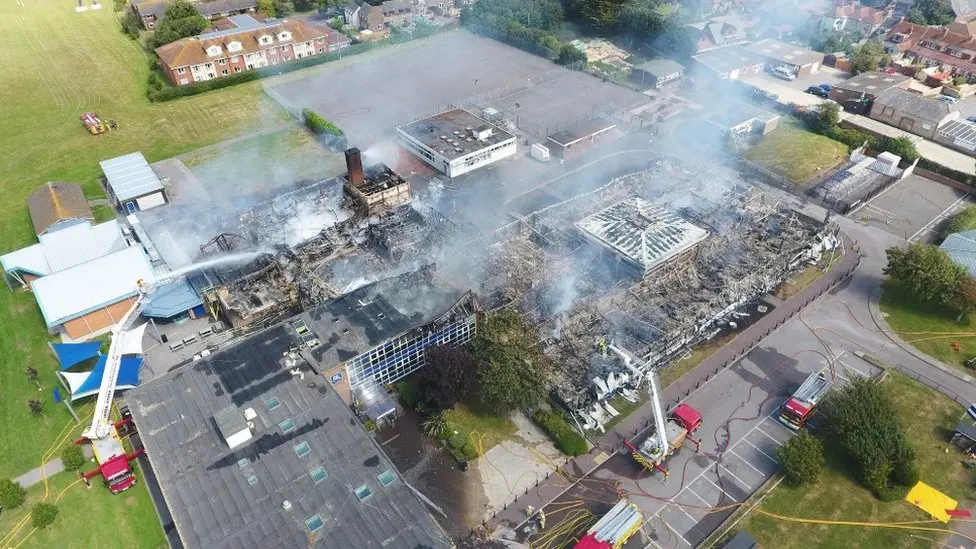
Case study 1: Selsey Academy, West Sussex, August 2016
On the morning of 21 August 2016, contractors were carrying out roof maintenance at Selsey Academy, a secondary school in West Sussex.
The first of more than 60 calls to the fire service came from a roofer reporting that a partition on the roof was alight.
More than 75 firefighters from West Sussex, Hampshire, East Sussex, and Surrey attended. At its height, 14 fire engines and two aerial ladder platforms were deployed.
West Sussex Fire and Rescue Service concluded that the most likely cause was accidental ignition during the roof maintenance work.
The fire spread rapidly, fanned by high winds, and the roofspace blaze affected approximately 75% of the main school building.
The estimated cost of the damage was around £20 million.
Around 400 pupils had to be relocated to temporary classrooms, sports centres, and community facilities while the school was rebuilt. It happened during the summer holidays, when no pupils were on site.
The consequences could have been considerably worse.
Case study 2: Dusseldorf Airport, Germany, 11 April 1996
The Dusseldorf Airport fire remains one of the most studied hot work disasters in the world.
It is directly relevant to anyone responsible for premises where contractors carry out maintenance work, and the lessons it offers are as applicable to a UK office block or shopping centre today as they were to a German airport terminal nearly three decades ago.
On 11 April 1996, welding work was being carried out on an expansion joint on the elevated access road above the arrivals hall of Terminal A at Dusseldorf Airport.
The work began at around 1.00pm.
The airport fire brigade had not been informed that welding was taking place. No fire watch was in position.
Droplets of hot material from the welding fell into the ceiling void below the access road. Inside that void was polystyrene insulation, highly flammable and used extensively throughout the ceiling construction. The material began to smoulder. Concealed from view, the fire spread slowly and silently across the ceiling void for approximately two and a half hours.
At around 3.30pm, a taxi driver noticed sparks falling from the ceiling in the arrivals area and alerted the fire brigade.
Two members of the airport fire crew arrived and initially suspected an electrical fault.
It was not until around 3.45pm, nearly three hours after the welding had taken place, that they learned of the hot work directly above and were able to identify the probable origin.
By then, it was too late to intervene effectively.
At 3.58pm, the smouldering polystyrene reached auto-ignition temperature.
A flashover occurred.
Within seconds, approximately 100 square metres of ceiling was ablaze, accompanied by an intense build-up of thick, black smoke. A total of 11 metric tons of polystyrene burned, along with PVC cable coatings, releasing highly toxic substances including carbon monoxide, dioxins, hydrogen cyanide, and hydrogen chloride.
There were no sprinklers.
There were no fire doors in the affected area, as neither was mandatory in the terminal at the time.
The air conditioning system continued to draw and distribute smoke throughout the terminal rather than being shut down.
The lifts were not taken out of service when the general fire alarm was triggered, and opened directly into the fire area.
Nine people died in the Air France VIP lounge on the mezzanine level above the arrivals hall, trapped by smoke and toxic fumes.
The lounge was not staffed. Passengers had been given an access code at check-in.
Despite numerous calls from inside the lounge during the fire, emergency personnel were unable to pinpoint the exact location of those trapped.
An escape route existed just eight metres from the lounge exit, but the smoke made it inaccessible.
All 17 fatalities died from smoke inhalation. Between 62 and 88 people were injured.
Around 1,000 firefighters were involved in extinguishing the blaze, at the time the largest fire response in the history of North Rhine-Westphalia.
Total damage was estimated at one billion Deutsche Marks.
The subsequent investigation revealed multiple systemic failures:
- The airport fire brigade had not been notified about the welding work. Had they been informed, a fire watch would have been deployed.
- The polystyrene insulation in the ceiling void had been installed in breach of building regulations and was not code-compliant.
- There were no operational procedures for a fire inside the terminal building.
- Firefighters lacked floor plans and access keys for the terminal.
- Communication between the airport fire brigade and the municipal fire service was severely inadequate. According to one municipal firefighter, the airport was effectively a blank spot to them, with the location of escape routes having been withheld by the airport’s own fire service.
Criminal charges were brought against the two welders, the technical director of the airport, the architect, and a number of building inspectors and supervisors.
After years of legal proceedings, the case was abandoned in 2001 without a verdict.
What the Dusseldorf fire illustrates with devastating clarity is this: hot work in a building introduces a risk that does not announce itself.
The fire smouldered for two and a half hours in a void above a busy, occupied public building.
No alarm sounded. No one noticed.
The spark that started it was invisible.
The combustible material it ignited was hidden.
By the time anyone realised what was happening, 17 people were already dead.
The same combination of factors, hot work near combustible building fabric, no notification to fire teams, no fire watch, concealed voids, and inadequate compartmentation, exists in countless UK buildings today.
Who does this affect?
The short answer is almost anyone who has contractors working on their building.
Hot work is not confined to major construction sites or airports. It happens in occupied offices, apartment blocks, restaurants, schools, care settings, and retail premises every day.
A plumber soldering a joint in a riser cupboard.
A contractor applying torch-on felt to a flat roof.
A maintenance engineer grinding a bracket in a plant room.
In all of these situations, the same underlying risks apply: sparks, heat transfer, combustible building fabric, and the very real danger that the fire starts after everyone has gone home.
What does UK law require?
The Regulatory Reform (Fire Safety) Order 2005 is the primary piece of fire safety legislation for non-domestic premises in England and Wales. It places a legal duty on the Responsible Person to identify and manage all sources of ignition as part of a suitable and sufficient fire risk assessment.
Where contractors are working on your premises, that duty does not transfer to the contractor. You remain responsible for managing the fire risks arising from work being carried out on your property.
The Building Safety Act 2022 built on this framework, particularly for higher-risk buildings, by strengthening the duties of those who control premises to maintain clear records and demonstrate ongoing compliance.
If a fire occurs and it can be shown that no hot work permit was in place, that the risk was not properly assessed, or that controls were not enforced, the Responsible Person may face enforcement action, prosecution, and significant difficulty with any subsequent insurance claim.
Commercial property policies typically include specific hot work conditions requiring a permit to be in place before any work involving heat or flame begins. Failure to comply can result in a claim being refused, even where the fire was accidental.
The GOV.UK fire safety guidance collection sets out the duties of Responsible Persons across a range of premises types and is a useful starting point for understanding what is required of you.
The most common hot work failures
In our experience, the problems that lead to fires are rarely dramatic. They are usually straightforward failures of management that, with a little planning, are entirely avoidable.
Work starts without a permit being issued. A permit is issued but no one checks whether combustibles have been removed from the area. The fire alarm is isolated while work is taking place but no one ensures it is reinstated before the contractor leaves. No fire watch is carried out after the work finishes.
The contractor has a RAMS document. The site contact signs it off without reading it properly. No one considers what is inside the wall cavity next to where the grinding is taking place.
These are not rare or unusual failures. They are common, and they are why hot work continues to cause preventable fires year after year.
What should you do next?
If contractors carry out any form of hot work on your premises, whether regularly or occasionally, you need a clear system for managing it.
That system should include a hot work permit process, a physical check of the area before work begins, clear rules about fire alarm isolation and reinstatement, a requirement for a fire watch after work concludes, and a reliable way of keeping records.
It does not need to be complicated. But it does need to be real. A permit that is signed without anyone physically inspecting the area provides no meaningful protection to you, your building, or the people in it.
ESI: Fire Safety works with businesses across Surrey and the South East to put practical, proportionate hot work controls in place. If you are unsure whether your current arrangements are adequate, or if contractors are about to start work on your building, we are happy to help.
Call ESI: Fire Safety on 01276 300351. We cover Surrey, Guildford, Woking, Epsom, Reigate, Redhill, Leatherhead, and the wider South East.
Related articles
- Do I Need a Hot Work Permit for Contractors on My Site?
- What Should Be Included in a Hot Work Permit?
- What Is a Fire Watch After Hot Works?
ESI: Fire Safety is a Surrey-based fire safety consultancy delivering fire risk assessments, fire safety training, and compliance consultancy to businesses across Surrey and the wider South East. ESI is a member of the British Fire Services Association and a CPD Group Approved Training Provider.